How to Pay for a VPN, Hosting and Domains with Crypto Privately
Pay for a VPN with crypto directly or with a crypto-funded virtual card, and do the same for hosting and domains. Options, privacy trade-offs and setup steps.
You can pay for a VPN with crypto in two ways: directly, if the VPN provider accepts crypto at checkout, or with a crypto-funded virtual card at any provider that takes Visa or Mastercard. The same two routes work for web hosting and domain names. Paying with a dedicated virtual card also keeps your main bank card out of the provider's billing system and makes renewals easy to control.
Why pay for privacy tools with crypto
People who choose a VPN or a host for privacy often notice a contradiction: the account is private, but the payment is linked to their bank card, name and billing address. Paying with crypto, or with a card funded by crypto, reduces how much personal data the provider holds.
Common reasons:
- Data minimisation. The less personal data a service stores, the less there is to leak if it's breached.
- Separating identities. Keeping a side project, a client site or a test server apart from your personal finances.
- No bank account needed. Useful when you keep your money in stablecoins.
- Controlled renewals. A dedicated card can be frozen or left unfunded when you want a subscription to lapse.
None of this changes your obligations. A VPN or a domain paid with crypto still has to be used within the provider's terms and the law; privacy is not a licence for abuse.
Option 1: pay the provider in crypto directly
Many VPN providers, and a growing number of hosting companies and domain registrars, accept crypto at checkout. Typically:
- You choose "crypto" as the payment method.
- The checkout, often run by a crypto payment processor, shows a coin, an amount and an address.
- You send the payment from your wallet before the quote expires.
Pros: no card involved, and the provider receives crypto rather than card data.
Cons:
- Not every provider offers it, and supported coins vary.
- Automatic renewal is often unavailable, so you renew manually each period.
- Refunds may be handled manually, if at all.
- Crypto payments are pseudonymous, not anonymous: transactions are public on most blockchains and can sometimes be linked to exchange accounts.
Option 2: use a crypto-funded virtual card
A crypto-funded card works at any provider that accepts Visa or Mastercard, so you're not limited to the few that take crypto directly.
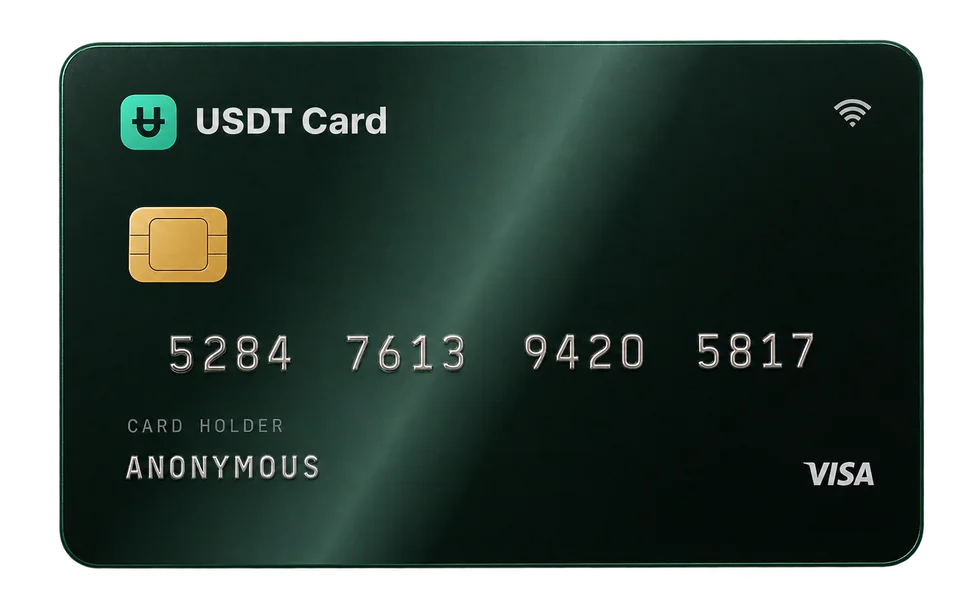
On USDT Crypto Card the setup looks like this:
- Sign up with a seed phrase; no ID documents or selfie. Confirm your email, which is required before depositing or creating cards.
- Deposit crypto in one of 10 assets (BTC, ETH, SOL, USDT, BNB, TRX, POL, LTC, AVAX, ARB). It's converted to USDT and held 1:1 with USD. See the funding section.
- Issue a dedicated card for the service, for $1. The default cardholder name is "Anonymous".
- Load it with at least $50 for the first load, enough for the plan and a margin.
- Pay at the provider's checkout. If a 3D Secure code is requested, it is sent to your confirmed email.
Pros:
- Works almost anywhere cards are accepted.
- Automatic renewals work, as long as the card has balance.
- One card per service means you can freeze or delete it without affecting anything else.
Cons:
- Card fees: $0.30 per approved transaction, plus a deposit fee of 2% on deposits under $300 (0% from $300).
- Some providers decline prepaid cards or particular BINs. Choosing a different BIN often helps; see what a BIN number is.
Direct crypto vs crypto card: comparison
| Pay in crypto directly | Crypto-funded virtual card | |
|---|---|---|
| Where it works | Only providers that accept crypto | Most providers that accept Visa or Mastercard |
| Auto-renewal | Often not available | Yes, while the card has balance |
| What the provider receives | A crypto payment | A card payment, with no bank account behind it |
| Stopping a renewal | Just don't pay | Freeze, empty or delete the card |
| Refunds | Often manual | Back to the card |
| Costs | Network fee, possibly processor spread | Network fee, deposit fee under $300, $0.30 per approved payment |
Paying for a VPN with crypto
VPNs are the simplest case. Plans are usually monthly or yearly, and many providers accept crypto, cards or both.
- Yearly plans mean fewer payments, which suits direct crypto payments without auto-renewal.
- Monthly plans suit a dedicated virtual card with auto-renewal.
- Account creation: some VPNs let you sign up with just an account number or a throwaway email. That pairs naturally with a crypto payment if you want minimal data linked to the account.
Buying hosting with crypto
Hosting has a few extra considerations:
- Billing continuity matters. A failed renewal can suspend a website or server. A dedicated card with enough balance, or a prepaid credit balance at the host, avoids surprise downtime.
- Usage-based billing. Cloud providers that bill by usage may charge variable amounts. Load a margin and watch the card's transactions.
- Card verification at sign-up. Some hosts run a small authorisation or a 3D Secure check when you add a card; see 3D Secure on virtual cards.
- Account and identity checks. Some hosts, particularly larger cloud providers, run their own verification on new accounts regardless of payment method. Follow their process.
Buying a domain with crypto
Domains bring one specific privacy point: registration data.
- The payment method doesn't decide what appears in public domain records. Contact details you give the registrar do.
- Many registrars offer WHOIS privacy or redaction that hides your contact details from public lookups. Availability depends on the registrar and the domain extension.
- Registrars and registries are generally required to hold accurate contact information, even when it's not public. Providing false details can put the domain at risk.
- Renewal is critical. An expired domain can be lost. Use auto-renewal on a funded card, or pay several years upfront.
Keeping it private without breaking anything
- Use one card per provider so you can see and control each renewal. Disposable virtual cards for subscriptions covers this pattern.
- Use a separate email address for privacy-sensitive accounts if you want them unlinked from your main identity.
- Secure the card account and your email with 2FA: the account holds your card details, and 3D Secure codes are sent to your email.
- Understand blockchain visibility. Moving funds from an exchange where you're verified creates a link, which is normal and legal; just don't assume crypto is anonymous.
For a broader look at what merchants actually see when you pay, read how to keep your online payments private.
Frequently asked questions
Can I pay for a VPN with crypto?
Yes. Many VPN providers accept crypto directly at checkout. If yours doesn't, you can pay with a crypto-funded virtual card, which works wherever Visa or Mastercard is accepted.
Is paying for a VPN with crypto anonymous?
Not fully. Crypto is pseudonymous: payments are visible on the blockchain and can sometimes be linked to exchange accounts. It does reduce the personal data the VPN provider stores.
Can I buy hosting with crypto and keep auto-renewal?
Usually only with a card. Direct crypto payments often need manual renewal, while a crypto-funded card renews automatically as long as it has balance.
Does paying for a domain with crypto hide my details?
No. What appears in domain records depends on the contact details you provide and whether the registrar offers privacy protection, not on how you pay.
What does it cost to use USDT Crypto Card for subscriptions?
$1 per card, $0.30 per approved transaction, and a 2% deposit fee under $300 (0% from $300). Top-ups from your balance to a card are free.